
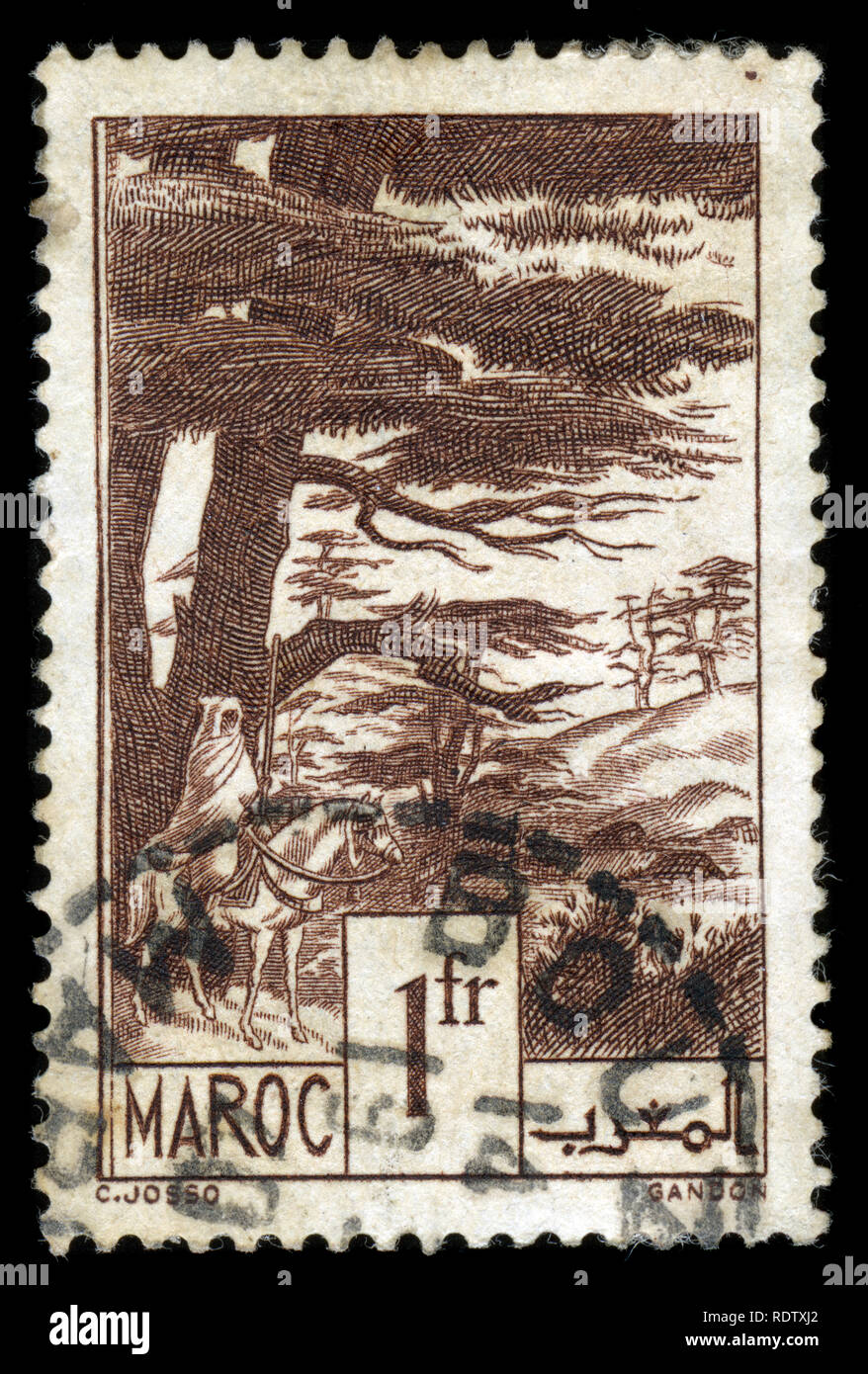
Morocco’s postal administration (Barid Al-Maghrib), alongside historic issues from the French Protectorate era, has a rich tradition of celebrating the country's exceptional natural geography and diverse botany. Spanning the Mediterranean coast, the towering Atlas and Rif mountain ranges, and the pre-Saharan steppes, Morocco’s stamps serve as a detailed canvas for its environmental heritage.
1. Protected Ecosystem Landscapes & National Park Regions
While modern administrative park names are rarely stamped verbatim as "National Park," the signature landscapes, protected forests, and ecological preserves that form Morocco’s national park system have been heavily featured across decades of postal releases.
-
The Atlas Cedar Forests (Ifrane & Middle Atlas Regions):
-
The dense, mountainous woodlands characteristic of Ifrane National Park and Tazzeka National Park have long inspired postal designers.
-
Classic issues—most notably the celebrated 1939 French Morocco pictorial series—featured detailed engravings of horsemen riding through the ancient cedar forests of the Middle Atlas, celebrating these high-altitude refuges. Subsequent environmental releases (such as World Forest Day issues) continued to spotlight these protected ecosystems.
-
-
The High Atlas Ranges (Toubkal & Eastern High Atlas):
-
Dramatic high-altitude peaks, deep limestone canyons, and traditional mountain topography mirroring areas like Toubkal National Park have frequently been captured in mid-century landscape definitives and tourism sets.
-
-
Coastal Wetlands and Lagoons (Souss-Massa & Khenifiss Regions):
-
Coastal reserves renowned for rich marine and avian biodiversity are frequently commemorated on stamps honoring wetland preservation, often paired with migratory birds and coastal flora.
-
2. Iconic Plant Species and Flora Featured on Stamps
Morocco sits at a unique botanical crossroads where Mediterranean, European, and African flora meet, featuring over 4,000 plant species. Postal issues have regularly turned to these plants to highlight native biodiversity:
-
The Atlas Cedar (Cedrus atlantica):
-
Undisputedly the most iconic tree species in Moroccan philately. Endemic to the mountain ranges of Morocco and Algeria, it has been featured on numerous forestry and conservation stamps (including 1930s definitive runs and 1980s environmental awareness blocks) to symbolize national forest conservation.
-
-
Wildflowers and Endemic Blossoms:
-
Across multiple decades—particularly in specialized nature sets released in 1973, 1980, 1983, and 1994—Moroccan postal authorities issued multi-value sets dedicated to regional flora. These stamps showcase delicate Mediterranean wildflowers, bulb plants, and localized coastal or mountain species.
-
-
Arid-Land and Steppe Vegetation:
-
Specialized botanical issues have occasionally highlighted xerophytic and desert-adapted plants—such as wild cucurbits, drought-resistant shrubs, and acacia-dotted steppe flora native to regions bordering the Sahara.
-
-
Agricultural and Cultural Flora:
-
Historical definitive sets have frequently honored the plants driving Morocco's agrarian economy, including olives, citrus varieties, cotton, and regionally prized aromatic crops.
-
Summary and Philatelic Value
Morocco's nature and plant stamps are valued by topical collectors not only for their artistic engraving and vibrant multi-color printing techniques, but also because they frequently align with national Nature Protection (Protection de la Nature) campaigns. They stand as a miniature archive of the country's commitment to safeguarding its vulnerable forests, mountain ranges, and fragile desert-edge ecosystems.

Philately has been considered as an "auxiliary science of history" because it is based on the general principles of other sciences, which in turn contribute to enrich it. It acquires knowledge of the sciences, of the arts, of languages and opens an immense road of social relations through all countries. This science broadens broad horizons of culture, discovers artistic temperaments and offers the interest of the new and the unknown, while performing a positive therapeutic wor.


