
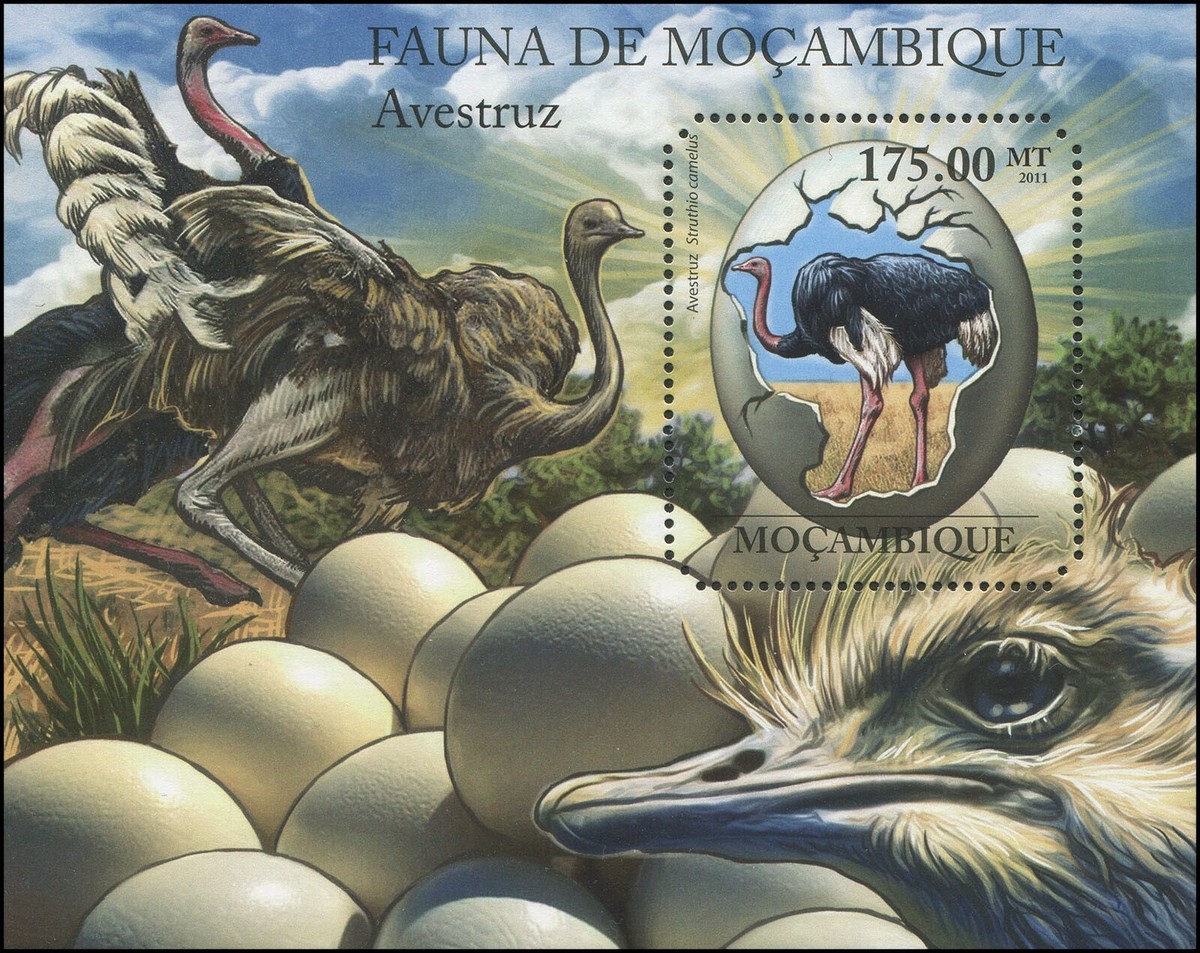
Mozambique’s rich philatelic output—particularly from its hallmark post-independence definitive sets and extensive thematic issues—features a wide array of sub-Saharan and migrant avifauna. Across multiple generations of stamp printing, certain striking species have consistently been chosen by postal designers to showcase the country's vibrant wildlife.
1. Iconic Savanna and Woodland Residents
Among the most frequently recurring species on Mozambique's stamps are the colorful, medium-to-large birds native to the nation's miombo woodlands and savannahs:
-
Purple-crested Turaco (Gallirex porphyreolophus): A frequent highlight of foundational post-independence definitive sets, prized for its vivid crimson and deep green plumage.
-
Lilac-breasted Roller (Coracias caudatus): Celebrated for its dazzling turquoise, mauve, and ochre coloration, making it a favorite subject for multi-value colorful series.
-
Common Ostrich (Struthio camelus): Regularly featured in large-format multi-value wildlife sets to represent the grand scale of African open-country fauna.
2. Raptors and Apex Predators
Birds of prey are heavily represented across Mozambique's stamp catalogs due to their dramatic appearance and ecological significance:
-
African Fish Eagle (Icthyophaga vocifer): One of the most frequently depicted raptors, symbolizing the vast river basins and lake systems of the region.
-
Secretarybird (Sagittarius serpentarius): Featured in specialized predatory and savanna ecosystem series.
-
Eurasian Eagle-Owl (Bubo bubo) & Western Osprey (Pandion haliaetus): Frequently showcased in global raptor sheetlets and specialized commemorative blocks.
3. Wetland Dwellers, Cranes, and Wading Birds
Given Mozambique's extensive coastline, floodplains, and wetland systems (such as the Zambezi delta), aquatic and wading birds occupy a major portion of the country's thematic issues:
-
Grey Crowned Crane (Balearica regulorum): Instantly recognizable by its striking golden crown and red throat pouch, frequently appearing in conservation-focused printings.
-
Marabou Stork (Leptoptilos crumenifer) & Yellow-billed Stork (Mycteria ibis): Staple subjects for large-format wildlife sheetlets.
-
Great White Pelican (Pelecanus onocrotalus): Regularly highlighted in marine and coastal bird collections.
4. Colorful Songbirds, Bee-Eaters, and Forest Dwellers
Smaller, brilliantly colored passerines and forest species round out the most common groupings on Mozambique stamps, offering intricate detail for close-up engraving and photogravure:
-
European Bee-eater (Merops apiaster): A perennial favorite that bridges European and African migrations.
-
Narina Trogon (Apaloderma narina): Showcased to highlight the deep, shadowy canopies of coastal and riverine forests.
-
Red-headed Weaver (Anaplectes rubriceps) & Violet-backed Starling (Cinnyricinclus leucogaster): Frequently included in multi-species definitive blocks to represent vibrant flocking birds.
Summary
While modern topical issues have occasionally expanded into global ornithology (featuring penguins, albatrosses, and hummingbirds), the core identity of Mozambique's bird philately remains rooted in native African species—led by turacos, rollers, fish eagles, and crowned cranes—that symbolize the ecological richness of the country.

Philately has been considered as an "auxiliary science of history" because it is based on the general principles of other sciences, which in turn contribute to enrich it. It acquires knowledge of the sciences, of the arts, of languages and opens an immense road of social relations through all countries. This science broadens broad horizons of culture, discovers artistic temperaments and offers the interest of the new and the unknown, while performing a positive therapeutic wor.


